Service Dog Tasks and the Public Access Test, Explained
This page explains the law in general terms. It is not legal advice. For a specific situation, contact the agency listed on this site or an attorney.
Two ideas sit at the center of service dog training: the tasks the dog performs, and how the dog behaves in public. People often mix them up, and they often assume a test decides whether a dog is legal. It does not.
This guide explains what counts as a task, how to build one, and how to use a public access test as a training benchmark. It is written for handlers in Iowa, so it also covers what Iowa law says.
The short answer
Under the ADA, a service animal is a dog that has been individually trained to do work or perform tasks for an individual with a disability. That definition comes from ADA.gov's Frequently Asked Questions about Service Animals and the ADA.
So when people ask what tasks a service dog can do, the answer is any trained work that is directly related to the handler's disability. The list is long because disabilities are varied.
The public access test is different. It is a training benchmark, not a legal requirement under the ADA. Assistance Dogs International (ADI) publishes a public access standard that programs use to judge whether a team is ready for public life. The ADA does not require a team to pass it, and no test or certificate is required by the ADA.
What counts as a task under the ADA
A task is something the dog does on purpose, on cue or in response to a sign, that helps with a limitation caused by the disability. The work must be directly related to the disability.
Here are examples of tasks, grouped by disability. These are illustrations, not a complete list.
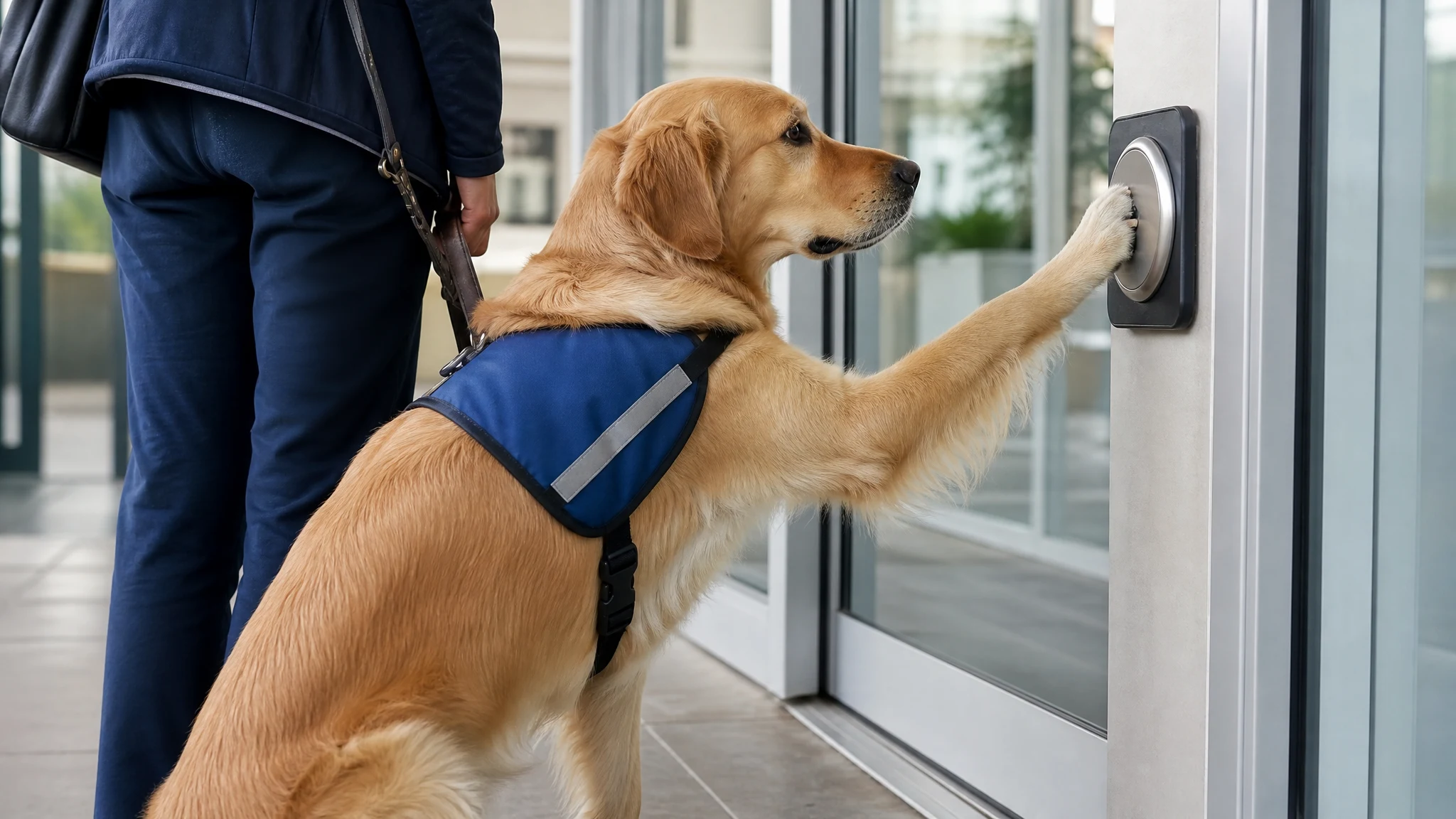
- Mobility disability: retrieving dropped items, opening doors with a pull strap, turning on lights, or providing bracing and balance support.
- Vision disability: guiding around obstacles and stopping at curbs and stairs.
- Hearing disability: alerting the handler to a smoke alarm, a doorbell or a name being called.
- Seizure disorders: staying with the handler during a seizure, or getting help.
- Diabetes or other medical conditions: alerting to a change the dog has been trained to signal, or fetching medication or a phone.
- Psychiatric disability or PTSD: interrupting a repetitive behavior, turning on lights and checking a room on cue, or applying trained pressure during an episode.
Iowa programs name some of these areas in their own materials. IOWA Service Dogs says it provides mobility and psychiatric service dogs. Puppy Jake Foundation lists mobility and military PTSD among the needs it serves. Check with each program for its current focus.
Why comfort alone is not a task
A dog that calms you by being near you is valuable, but presence alone is not a task. Emotional support, therapy and comfort animals are not service animals under the ADA. The difference is individual training to do work or perform tasks.
Compare two cases. A dog that is simply nice to have around when its person feels anxious is providing comfort. A dog trained to wake its handler from a nightmare on cue, or to nudge a hand away from a harmful behavior, is performing a task.
This matters for access. Only a dog that meets the ADA definition has the ADA's public access rights. If you are unsure which category your dog falls into, review the ADA.gov FAQ linked in the Sources below.
What Iowa law adds
Iowa's definition tracks the federal one. Iowa Code 216C.1A says a service animal means a dog or miniature horse as set forth in the ADA Title II and Title III regulations. The same section defines a service-animal-in-training as an animal undergoing a course of development and training to do work or perform tasks directly related to a person's disability.
Under Iowa Code 216C.11(1), a person with a disability, a person assisting one by controlling a service animal, or a person training a service animal may bring the animal, under control, into the public places listed in 216C.3 and 216C.4 without an extra charge. The handler is liable for any damage the animal does. Those places include public buildings, common carriers, hotels, eating places and other public accommodations.
Iowa Code 216C.11(2) makes knowingly denying or interfering with that right a simple misdemeanor. Section 216C.11(3) covers intentional misrepresentation of an animal as a service animal or service-animal-in-training to obtain rights or privileges. That is also a simple misdemeanor. The Iowa Legislature's explanation of HF 615, enacted as 2025 Acts, chapter 111, gives the penalty as up to 30 days of confinement and a fine of at least $105 and not more than $855.
The sources reviewed do not state any age, harness, ID or professional-trainer condition for dogs in training. If you are training a dog in Iowa, confirm current rules with the Iowa Office of Civil Rights before relying on in-training access.
For a wider look at Iowa law, programs and costs, see our guide to service dog training in Iowa, including laws, programs and costs.
The public access test as a training benchmark
ADI is a coalition of assistance dog programs. Its public access standard is used by many programs to check that a dog behaves reliably in public. The Iowa listings for Puppy Jake Foundation and Retrieving Freedom appear in the ADI member directory.
Three points keep this in perspective:
- The ADA does not require a public access test, a certificate or a registry.
- Staff at a business may ask only two questions when the need is not obvious: is the dog a service animal required because of a disability, and what work or task has the dog been trained to perform?
- A test is useful because it tells you honestly whether your dog is ready, not because it creates legal status.
I am not reproducing the individual test items here. ADI sets and updates them, so use ADI's current published standard as your checklist.
No online registration, ID card or certificate is legal proof of anything under the ADA. Do not buy one expecting it to open doors.
How to train a task and prepare for a public access test
Materials you will need
- A flat buckle collar or a well-fitted harness, plus a standard six-foot leash.
- Small, soft, high-value treats, and your dog's regular meals for lower-value rewards.
- A clicker or a consistent marker word such as "yes."
- A notebook or phone notes to track each task and each outing.
- Task tools as needed, such as a door pull strap, a light switch target or a retrieve object.
- A helper who can act as a distraction.
- A mat or small blanket for settling practice.
Use only humane, reward-based methods, in line with the American Veterinary Society of Animal Behavior. Do not use shock, prong or choke collars, alpha rolls, scruffing or dominance methods. They add fear and can make public work less reliable.
Step 1: Name the need
Write down the specific limitation each task will address. If a behavior does not connect to your disability, it may be a good manner, but it is not a task.
Step 2: Write a task list
List each task in plain words: the cue or trigger, what the dog does, and how you will know it worked. Keep it short. Two or three reliable tasks beat ten shaky ones.
Step 3: Break each task into small pieces
Teach one tiny step at a time. For a retrieve, start by rewarding the dog for looking at the object, then touching it, then mouthing it, then carrying it. Mark and reward each step. Raise the difficulty only when the dog succeeds easily several times in a row.
Step 4: Add the cue
Once the dog does the behavior reliably, attach a word or signal just before it. If the task is a response to a trigger, such as a sound or a change in your body, pair the trigger with the behavior and reward the dog for responding.
Step 5: Practice in new places
Dogs do not generalize automatically. Practice each task at home, in the yard, then in quiet public spaces. Return to an easier level when you enter a new place. This is normal.
Step 6: Build public manners
Work on the habits a public access test looks for in general: a loose leash, settling on a mat, ignoring dropped food, staying calm around people and other animals, and entering and exiting doorways politely. Short, successful outings are better than long ones that end in stress.
Step 7: Run a mock test
Take the current ADI public access standard and walk through it with a helper. Note where the dog struggles. Do not rush the dog through the weak spots. Train those pieces separately, then retest.
Step 8: Review and keep training
Public access is not a one-time finish. Dogs change with age, health and environment. Keep logging outings and return to basics when behavior slips.
Tips
- Train when the dog is rested and fed lightly, not hungry or tired.
- End each session on a success, even a small one.
- Reward calm behavior often, especially when the dog is ignoring something exciting.
- Watch your dog's stress signals, such as lip licking, yawning or turning away. Take a break when you see them.
- Ask a qualified trainer who uses reward-based methods for help with problem spots. Ask what methods they use before you book.
Common mistakes to avoid
- Counting comfort as a task. If the only thing the dog does is be present, it is not a task under the ADA.
- Treating a test as a legal gate. Passing a test does not create ADA rights, and failing one does not remove them.
- Buying a registration or ID. No official registry exists under the ADA.
- Going out too soon. A dog that is not ready can have a bad experience that sets training back.
- Using harsh corrections. They can hurt your dog and damage trust, and they are not part of a humane program.
- Misrepresenting a pet. In Iowa, intentionally misrepresenting an animal as a service animal to gain rights is a simple misdemeanor.
Expected results
With steady, reward-based practice, many teams find that tasks become more reliable and public outings calmer over months. Timelines vary widely by dog, handler, task and disability. No method guarantees a particular outcome, and some dogs are not suited to public work. That is a good reason to evaluate your dog honestly.
Iowa programs may help with training or with placing a dog. None of the programs reviewed publishes a price or waitlist, except that IOWA Service Dogs says its dogs are provided at no charge, and a 2026 KTIV report says Partners for Patriots provides service dogs to veterans or their family members for free. Check with each program for current details.
Veterans should know that the VA Service Dog Veterinary Health Benefit covers only dogs from programs accredited by ADI or the International Guide Dog Federation. It applies to veterans with a visual, hearing or substantial mobility impairment. Confirm accreditation status with the program and the VA before you rely on the benefit.
If access is denied
This guide is not legal advice. If you believe you were wrongly denied access or housing, contact the Iowa Office of Civil Rights, which houses the Iowa Civil Rights Commission. It is at 6200 Park Avenue, Suite 100, Des Moines, IA 50321-1270, phone 515-281-4121. Complaints must be timely and must allege acts covered by the Iowa Civil Rights Act, so ask the agency about the filing deadline.
Sources
- ADA.gov, Frequently Asked Questions about Service Animals and the ADA
- Animal Legal & Historical Center, Iowa Code Annotated ch. 216C
- Iowa Legislature, HF 615 bill text and explanation
- Iowa Office of Civil Rights, assistance animal page
- Assistance Dogs International, Iowa member directory
- VA Prosthetic and Sensory Aids Service, Service Dog Veterinary Health Benefit
- IOWA Service Dogs
- KTIV, Partners for Patriots report (March 11, 2026)